
Imagine asking two people the same question: “Is this train ticket valid?” The first is a chatty friend who writes you a lovely three-paragraph essay about ticket rules, travel history and how they feel about the Monday rush. The second is the ticket checker at the gate, who glances down and says “yes” in a blink.
Most AI tools you have met are the chatty friend. Jev is the ticket checker. It never writes a single sentence. It only makes decisions, and it hands them straight to other software.
And it makes them fast. That speed is the reason people are talking about it.
The short version
- What: Jev is an AI model from TypeSafe AI, a San Francisco startup. It is the first of what the company calls “System One Models”.
- How it’s different: It doesn’t write text. It returns choices, scores and yes/no probabilities that software can use directly.
- Speed: Reports differ: TypeSafe says 70 to 500 milliseconds per answer, while its lead investor DCVC says under 100 milliseconds.
- Price: US$0.042 per million input tokens, and output is free. TypeSafe admits this price may be subsidised.
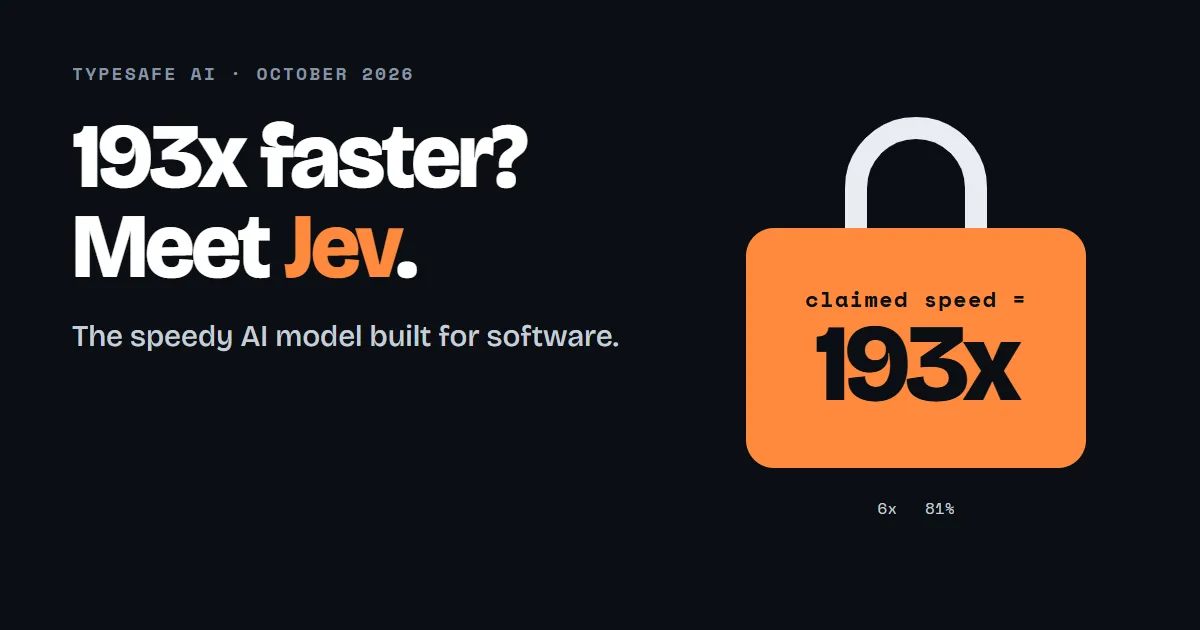
- The twist: An independent test found Jev genuinely faster than other models, but nowhere near the 193x the company advertises.
- Latest: An US$870 million funding round at a US$7.5 billion valuation on 9 October 2026. Jev is still in waitlisted early access.
The story: from stealth to a $7.5 billion valuation
TypeSafe AI was founded in 2024, and the team spent about two years working on Jev in stealth, which means building quietly without telling the world.
On 15 September 2026, TypeSafe stepped out of the shadows. It released Jev in limited early access and announced a US$40 million seed round led by the venture firm DCVC.
Then things moved quickly:
- On 5 October, an independent tester, Concret.io, published a head-to-head comparison of Jev against 15 other AI models.
- On 9 October, TypeSafe announced an US$870 million Series A at a US$7.5 billion valuation. Andreessen Horowitz (a16z) led it, with Sequoia Capital, DCVC and angel investors joining in.
- Same day, Martin Casado of a16z was announced as joining TypeSafe’s board.
TypeSafe also claimed that a third of Fortune 500 companies are using Jev, and that it has already saved customers millions of dollars. Nobody has independently checked that. a16z reportedly put the figure at 25%, not a third.
Meet Jev: an AI that decides instead of writes
The name “System One” comes from psychologist Daniel Kahneman’s book Thinking, Fast and Slow. He split thinking into two modes: System One, the fast gut instinct you use to catch a falling cup, and System Two, the slow careful thinking you use to fill in your tax return.
Chatbots like ChatGPT are LLMs (large language models): AI that reads and writes text, building replies a little at a time. They measure text in tokens, small chunks of text that are often a word or part of a word.
Jev is a different animal. It’s a discriminative model, which means it picks between answers instead of writing new text. You can ask it three kinds of question:
- Noul: a yes/no judgment with a probability. “Is this email spam?” → yes, 92% likely.
- Choice: pick one option from a list. “Which team should get this complaint: billing, delivery or refunds?” → delivery.
- Score: place something on an ordered scale. “How urgent is this message?” → high.
Every answer comes with a confidence estimate, and it is meant to be read by software, not by you.
The trade-off is total. Jev cannot write explanations or prose at all, and TypeSafe itself calls the model “still in its early days”.
Is it really that fast? The claims vs the tests
TypeSafe’s headline is eye-catching. In its own workflow tests, it says Jev was 193.6 times faster and 444.6 times cheaper than frontier LLMs, the most powerful models around. Across its wider tests, the company’s range works out to roughly 40–200 times faster and 40–400 times cheaper.
To its credit, TypeSafe is upfront about the caveats. The tests ran from laptops on the US West Coast, used workflows its own team built, and probably show the high end of real-world gains.
So what happened when someone else tried?
The independent test
Concret.io pitted Jev 1.13 against 15 LLMs. Here’s what it found:
- Speed: Jev was the fastest of all 16 models in every test, at 0.38 seconds per ticket.
- Against the big names: About 6 times faster than Claude Sonnet 5, and 2 to 6 times faster than everyday models.
- Accuracy: Jev scored 81% on 200 banking questions, matching six of eight everyday LLMs.
- Against the top tier: On a subset where Jev scored 80%, the seven most expensive models scored 90–96%.
Concret.io’s conclusion: the 193x speed and 445x cost figures couldn’t be reproduced. In its view, Jev’s real edge is a single- or double-digit multiple. Still impressive. Just not 193.
It also reported that another tester, NXTG.AI, found Jev “not calibrated as claimed” on 4 of 5 question types. More on what “calibrated” means in the nerdy bit.
The “can’t hallucinate” claim
A hallucination is when an AI confidently makes something up. TypeSafe claims Jev cannot hallucinate, because every answer must fit a template defined in advance.
That’s the company’s own claim. It also admits the 0% hallucination figure isn’t based on measured tests.
Where Jev is useful (and where it isn’t)
TypeSafe pitches Jev for the many tiny decisions hiding inside software:
- Classifying, routing, scoring, extracting and branching: sorting things, sending them to the right place, rating them and deciding what happens next.
- Map-reducing over large datasets: asking the same small question across huge piles of data.
- Real-time apps where every millisecond counts.
- Guardrails and jailbreak detection.
Guardrails are safety checks that stop an AI app from doing something it shouldn’t. A jailbreak is a sneaky prompt designed to trick a chatbot into breaking its own rules. A fast, cheap yes/no checker is a natural fit for spotting those.
TypeSafe showed off two fun demos. One was a bot playing the classic game Doom from a text description of the game, answering about 10 questions a second for roughly US$7 an hour. The other raced through Wikipedia links.
For an everyday example, think of a company drowning in customer support tickets. Concret.io suggests using Jev as a first filter: it tags and routes the easy ones in a blink and passes the unsure cases to a human. LLMs, it says, should still handle the writing and reasoning.
The weak spots
Concret.io found Jev struggles with:
- Large documents
- Non-English text
- Maths
- Dates
It also can’t be fine-tuned (custom-trained on your own data), and it runs only on TypeSafe’s own servers.
What about India? No source says whether Jev is offered here or how it handles Indian languages.
What you should do
If you’re an everyday user
Nothing at all. You won’t chat with Jev. If you meet it, it’ll be invisibly, inside an app quietly deciding where your message goes or whether a request looks unsafe.
If you’re a developer or on a product team
- Join the waitlist: Jev is still in early access.
- Try it on Cloudflare’s AI platform, where it’s listed as
typesafe/jev. - Test it on your own data before trusting the big multiples.
- Keep an LLM for anything that needs writing or reasoning.
- Don’t plan long-term budgets around today’s price. TypeSafe says it may be subsidised.
The nerdy bit: how does one AI answer five questions at once?
Grab a chai. This is the part for the curious.
State and questions in, typed answers out
Using Jev looks like handing someone a form. You send a state (the context, as plain text or structured data) plus a set of named questions. Jev sends back an answer for each, with probabilities, plus a count of tokens used.
Roughly, in pseudo-code:
state: "Customer: My parcel never arrived and I want my money back."

questions:
  is_angry     → yes/no
  department   → choose from [billing, delivery, refunds]
  urgency      → score on [low, medium, high]

answers:
  is_angry     → yes (0.88)
  department   → delivery (0.74)
  urgency      → high (0.81)
Every question has a schema, a fill-in-the-form template that spells out exactly which answers are allowed. Jev can’t reply “purple” to a yes/no question, because purple isn’t a box on the form. That’s why TypeSafe says type errors are “mathematically impossible”.
All at once, not word by word
A typical LLM writes like a person typing: one token, then the next, then the next. Jev answers all its questions in parallel, in a single pass.
Think of a quiz. Writing an essay answer takes ages. Ticking all the boxes on a multiple-choice sheet takes seconds.
The catch: if question two depends on the answer to question one, Jev can’t see it in the same pass. Those questions have to go in separate requests.
Trained to be honest about uncertainty
TypeSafe trained Jev with a method it calls Reinforcement Learning for Calibrated Decisions (RLCD). Unlike RLHF, the treat isn’t a human liking the answer. The goal is calibrated probabilities.
Calibration is what makes a good weather forecast. If it says “70% chance of rain” on a hundred days, it should actually rain on about seventy of them. A calibrated Jev saying “88% yes” should be right about 88% of the time. That’s exactly what NXTG.AI reportedly found lacking on 4 of 5 question types.
Beyond that, details are thin. Jev is reportedly trained only on synthetic data (examples generated by computers rather than collected from people). TypeSafe describes it only as transformer-based, the same basic design behind most modern AI, and hasn’t published a paper, the model’s size or its weights.
How much can it read at once?
A context window is how much text a model can take in at one go. Reports differ: Cloudflare lists Jev at 32,000 tokens, while TypeSafe’s API docs reportedly allow 64k per input, of which 32k can be the state plus the longest question.
Cloudflare also lists it as version jev-1.13.0 with zero data retention, meaning your inputs aren’t kept.
What we can all learn from this
- Not every AI job needs a chatbot. Lots of tasks are just decisions: yes or no, this or that, low or high.
- Company benchmarks are a starting point, not a verdict. 193x became single or double digits once someone else tested it.
- Cheap today may not be cheap tomorrow. A possibly subsidised price is a promotion, not a promise.
- Speed is worth little without accuracy. A fast 81% still trails a slower 90–96% when mistakes are costly.
- Keep a human in the loop for the unsure cases. Let the machine handle the obvious ones and send the rest to a person.
The bottom line: Jev is genuinely fast and cheap for yes/no-style work, even if the real edge is smaller than the headline. It’s still waitlisted, and there’s been no news since its big funding round on 9 October.
Think of it as the world’s quickest ticket checker. Brilliant at “yes” or “no”. Just don’t ask it to write you a thank-you note.