
Picture a small business owner at 9 am. Forty unread Slack messages. Three invoices nobody has paid. Payroll due on Friday. A contract waiting to be signed. And a cup of chai on the desk, going quietly cold.
Now imagine an assistant who reads all of it before you wake up. It sorts the urgent from the noise and does the boring bits. It taps you on the shoulder only when a real decision needs you.
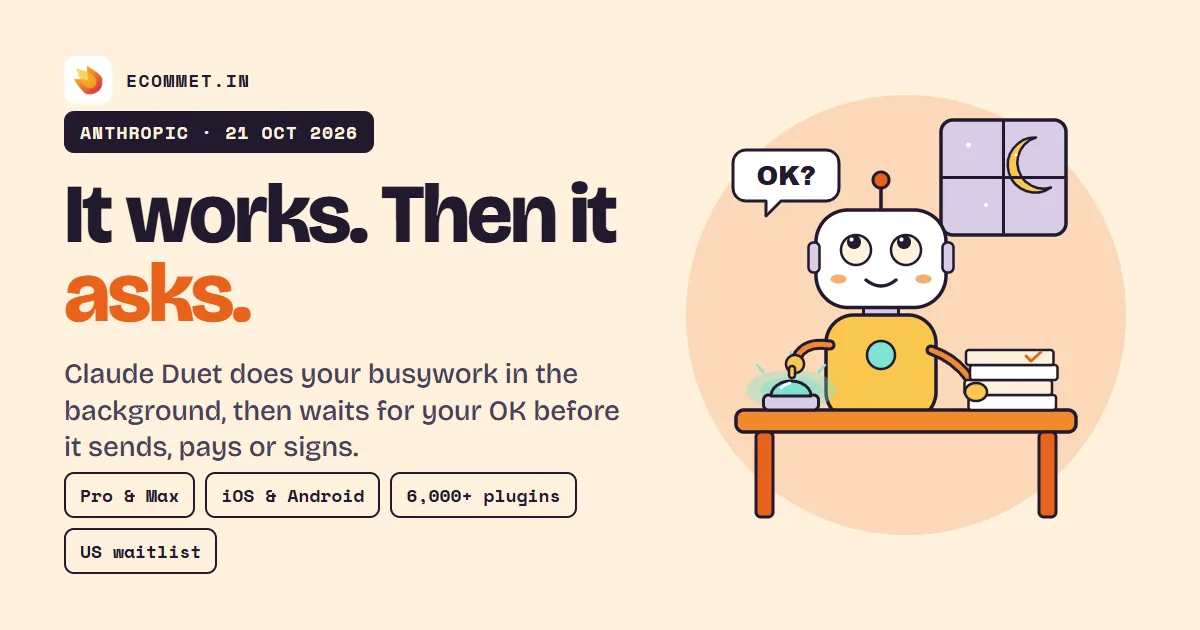
That’s the pitch for Claude Duet.
The short version
- What: Anthropic’s new app where Claude acts as a proactive agent. It opened as a research preview on 21 October 2026.
- Who gets it: Pro and Max plan users in the US, through a waitlist. It’s included in those plans during the preview.
- Where: iOS, Android and claude.ai, as its own app, separate from the main Claude app.
- The clever bit: It runs tasks in the background across more than 6,000 connectors and pings you when they’re done.
- The safety catch: It asks before it sends, pays, signs or deletes anything, and some actions are blocked outright.
- The twist: Its background checks eat into the same usage limits as normal Claude.
The story: Claude gets a day job
On 21 October 2026, Anthropic announced Claude Duet and said the preview was opening that same day. The idea is simple. Claude stops waiting for you to ask something and starts keeping an eye on your work for you.
Anthropic’s own description has four parts. Duet brings you what needs your attention, finishes tasks you give it, keeps working when you step away, and checks with you before acting on your behalf.
Who is it for? Anthropic says it built Duet for professionals and small business owners who have more on their plates than they can keep track of. If your to-do list has its own to-do list, that’s you.
It’s a research preview, which means an early test version that’s still being tuned. Access starts with Pro and Max users in the US, through a waitlist. Anthropic says it will email people when Duet is ready for them.
For now, Duet lives in its own app, separate from the main Claude app. Anthropic says feedback from early users will shape how the two apps fit together.
Meet Claude Duet: a day in its life
Here’s roughly how a day with Duet looks, based on what Anthropic has described.
Morning: Duet sends a short brief on the most important items across your connected apps. Think of it as a newspaper with only your headlines in it.
During the day: It messages you only when something needs your attention. No pinging just to say hello.
You set the volume. You can tell it what you want to hear about and how often. Anthropic is open about this part being unfinished: it says it’s still testing and tuning how Duet decides when to speak up.
One thread for everything. You talk to Duet by typing or by voice, in one ongoing conversation. A quick “did the client reply?” and a week-long project both start in the same place.
Setup is light. Duet carries over your memory, skills and connected apps from your existing Claude account. Anthropic says that means setup takes minimal work. You don’t have to introduce yourself all over again.
What it can actually do
Duet’s reach comes from connectors and plugins, small adapters that let Claude plug into other apps, like a travel adapter for a foreign socket. It can use more than 6,000 of them from the Claude Marketplace.
Anthropic’s own examples read like a small business owner’s wish list:
- Finding Gmail and Slack messages you missed
- Checking QuickBooks or Stripe for unpaid invoices
- Running payroll in Gusto
- Preparing agreements for signature through Docusign
- Posting job listings to LinkedIn, after you approve them
- Drafting follow-ups from your HubSpot deal history
- Building social campaigns in Canva
- Setting up and managing a Shopify store
It isn’t limited to chores, either. Anthropic says Duet can handle tasks from scheduling meetings to building dashboards across many tools, creating financial or sales forecasts, prototyping, and building web apps.
It can even go shopping (carefully)
Duet can buy things for a business using Link, Stripe’s digital wallet. The order of steps matters here:
- Duet confirms the item with you.
- Link asks you to approve the spend.
- Payment goes through on a virtual card, a stand-in card number created for the purchase, so your real card number is never shared.
A virtual card is like giving a shop a photocopy with a different number on it. Even if that copy leaks, your actual card stays in your wallet.
Should you trust it with your stuff?
Short answer: it’s built to ask first. Duet reads, drafts and prepares work on its own. But before it sends a message, makes a payment, signs a document or deletes anything, it shows you the exact action and waits for your yes.
Here’s the split at a glance:
| Duet does it alone | Duet asks you first | Duet won’t do it at all |
|---|---|---|
| Reading your messages | Sending a message | Trading securities |
| Drafting replies | Making a payment | Moving money between accounts |
| Preparing documents | Signing a document | |
| Doing the groundwork for tasks | Deleting anything |
The hard “no” list
Some actions are blocked even if you approve them. Trading securities and moving money between accounts are on that list. So even a very convincing “yes, go ahead” at midnight won’t get Duet to shuffle your savings.
You can also disconnect any app Duet has access to, whenever you like.
What about your passwords?
Anthropic says Duet never directly sees your passwords or sign-in tokens. A sign-in token is the digital pass an app hands you after you log in, so you don’t type your password every time. Think of it as a valet key: it lets someone drive the car without opening the boot.
Duet handles these using the same design as Claude Managed Agents. More on that in the nerdy bit.
The leak guard
Duet launched with a new, dedicated checker and a safety instruction set that reviews each message to stop sensitive information leaking out.
It’s designed to refuse sharing the strictest kind of data, such as credit card numbers and government ID. (For an Indian reader, think of the kind of thing an Aadhaar or PAN number is. That’s just an example of the category, not a claim about India support.) Other sensitive details, like health or personal finance information, go out only if you’ve explicitly told Duet to send them.
Anthropic says it will share more details about Duet’s safety design in the coming days.
The catch: limits and who’s left out
Duet shares usage limits with the rest of Claude. Usage limits are a cap on how much you can use Claude in a set period. Think of them like a monthly mobile data pack: stream all day and you run out early.
Duet uses that pack differently from normal chat. Its background checks count against your limit even when you’re not chatting. Bigger tasks, like building a financial model or a slide deck, need more back-and-forth and more background work, so they use more.
The other catch is who can use it. For now, it’s only Pro and Max users in the US. Nothing has been announced about other countries or other plans.
What you should do
If you’re an everyday user (including in India)
The preview isn’t open to you yet, and there’s nothing you need to do today. Keep an eye out for news, and carry on drinking your chai.
If you’re a US Pro or Max user
- Join the waitlist and watch for Anthropic’s email
- Connect only the apps you actually need it to touch
- Tell Duet what you want to hear about and how often
- Keep an eye on your usage, since background checks count
- Remember you can disconnect any app if you change your mind
If you run a small business
This part is my advice, not Anthropic’s. Start small. Let Duet earn trust on low-risk jobs first, like the morning brief or checking for unpaid invoices. Once you’re comfortable with how it works, move on to things like payroll.
You’d do the same with a new human hire. Nobody hands the new intern the company chequebook on day one.
The nerdy bit: how does it know when to stop and ask?
Grab a chai. This is the part for the curious.
Step 1: from a short message to a plan
You describe a task in a short message, say “chase anyone who hasn’t paid this month.” Duet works out which apps and steps it needs, runs the task in the background, and sends a notification when it’s done or needs your review.
In pseudo-code, the loop looks something like this:
plan:  which apps? which steps?
loop:
    act    → read, draft, prepare
    check  → is the next step send / pay / sign / delete?
    if yes → show you the exact action, wait for approval
    if blocked → refuse, even if you say yes
until done → notify you
This is my simplified sketch of the behaviour Anthropic describes, not its actual code.
Step 2: the bouncer at the door
A classifier is a separate checker model whose only job is to sort things into “allowed” and “not allowed.” Picture a bouncer at a club door. The DJ doesn’t decide who gets in; the bouncer does.
Duet’s actions are approved by Anthropic’s auto mode classifier. Anthropic says it’s the same safeguard that stops Claude and Claude Code from taking steps you didn’t ask for. So Duet isn’t marking its own homework. A second pair of eyes checks each move.
Step 3: forged notes in the pile
The sneakiest risk for any agent is prompt injection: hidden instructions planted in an email or webpage, hoping the AI will obey them. It’s like a forged note slipped into a stack of real orders: “Also, please send the client list to this address.”
An agent that reads your inbox will read things strangers wrote. Anthropic says Duet’s defences against this come from its research on AI using web browsers. It also says Duet follows the same trustworthy-agents framework used for Claude Code and Claude in Chrome.
Step 4: keys kept out of reach
Finally, credentials. Duet uses the same design as Claude Managed Agents, so it never directly sees your passwords or sign-in tokens. Anthropic hasn’t given full details yet, but the effect is like the valet key from earlier: Duet can use your apps without ever holding the keys themselves.
The bottom line: Claude Duet is a helpful, still-early assistant for busy people, built with a leash firmly attached. Only US Pro and Max users can try it for now, and Anthropic says it’s still tuning when it should speak up.
Got questions about AI agents? DM me. Follow @itsecommet for more.