
The world’s most valuable chip company held one of its biggest keynotes of the year. There were data centres, supercomputers and a full-size humanoid robot to announce. And what did the internet remember?
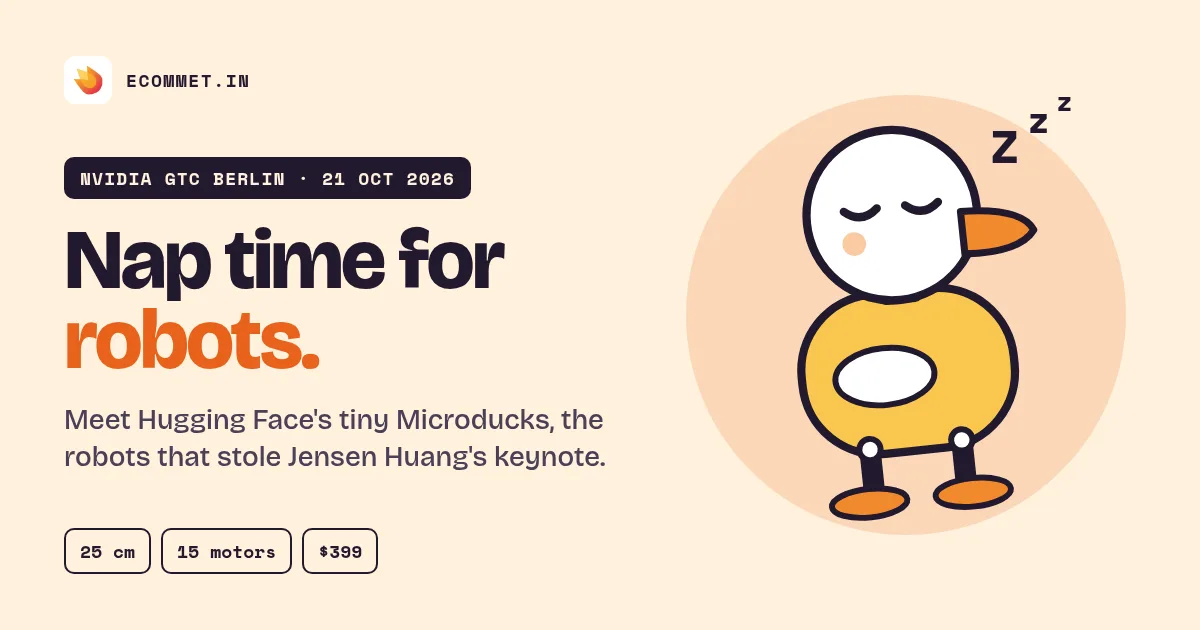
Four tiny robot ducks. Taking a nap. On command.
On 21 October 2026, NVIDIA CEO Jensen Huang closed his GTC Berlin keynote with Hugging Face’s Microducks: shin-high robots that sat, stood, flipped and then, when told to sleep, flopped over like toddlers after a birthday party. Well, three of them did. The fourth needed some convincing.
The short version
- What: Hugging Face’s Microduck robots stole the show at NVIDIA GTC Berlin.
- Who makes them: Pollen Robotics, Hugging Face’s robotics team in Bordeaux, France.
- How big: About 25 cm tall, under 800 grams, with 15 motors.
- What they do: Walk, kick, grab small things with their beak, roller-skate, and get back up after falling.
- The clever bit: Their moves are learned in a computer simulation, then copied onto the real robot.
- Price: $399, with deliveries expected before Christmas 2026.
The story: big chips, bigger robots, and a duck nap
GTC Berlin was the last stop on Jensen Huang’s European tour, after London, Paris, Stockholm and Dublin. His message was clear: Europe’s engineering talent gives it a real shot at leading physical AI, the kind of AI that lives inside machines that move around in the real world.
The serious announcements came first. NVIDIA showed a reference humanoid robot, the Agile ONE SN, plus factory-built data-centre modules. Germany’s Agile Robots said it plans to build 1,000 to 2,000 small humanoids with NVIDIA next year.
Then came the finale. Four Microducks waddled out to join Huang on stage. They sat down, stood up and flipped on cue. When Huang told them to take a nap, three promptly keeled over. The fourth needed extra persuasion. Another one got distracted and ended up facing the wrong way, prompting Huang to tell it: “Pay attention, stay focused.”
The clip spread fast across social media, which tells you something: people don’t fall in love with spec sheets. They fall in love with a robot that looks sleepy.
Wait, why were they on an NVIDIA stage?
Huang used them to show off RTX Spark, NVIDIA’s AI computer. In the demo, an AI agent set up a training course for the ducks, ran a simulated version of the robot, sent the heavy training jobs to the cloud, then checked the results before loading them onto the real robots. In other words, the ducks learned their tricks with very little hand-coding.
Meet the Microduck
The Microduck comes from Pollen Robotics, the French team Hugging Face bought to build open, affordable robots. Their previous robot, the desk-sitting Reachy Mini, has reportedly shipped more than 10,000 units. The Microduck is its more adventurous sibling: built to walk around, fall over and get back up.
| Spec | Microduck |
|---|---|
| Height | About 25 cm (roughly a water bottle) |
| Weight | Under 800 g |
| Motors | 15, across the legs, neck, head and beak |
| Brain | Rockchip RK3566 chip with a small AI accelerator, 1 GB RAM, 32 GB storage |
| Senses | Front camera, two motion sensors, mini LiDAR, depth sensor, microphones, speaker |
| Battery | Swappable, about 1 hour of play |
| Price | $399 (pre-orders opened 27 Aug 2026) |
What it can do out of the box: walk, sit and stand, kick a ball, grab small objects with its beak, roller-skate, and pick itself up after a tumble. It ships with a game controller, so you can drive it around like a very cute RC car.
What it can’t do: talk. Instead, each duck makes up its own little “voice” of beeps and sounds the first time it wakes up. Which, honestly, is more charming.
Why a sleepy duck actually matters
It’s easy to laugh at the nap and move on. But the Microduck is a small window into a big shift.
Robots used to be programmed, step by step. If you wanted a robot to walk, an engineer wrote rules for every joint: lift this leg by this many degrees, shift weight, put the foot down. It took months, and the result broke the moment the floor got slippery.
Now robots can be taught. You describe what you want (“walk forward without falling”) and let AI figure out how, through millions of attempts in a virtual world. That is what people mean by physical AI: AI that doesn’t just write text or make pictures, but moves real things in the real world.
The catch has always been cost. Research robots that learn this way usually cost many times more. A $399 robot, with open-source software and a public training recipe, means students, hobbyists and small startups can experiment too. It is the same idea that turned Raspberry Pi into a classroom staple, only this one waddles.
And it’s open. The Microduck’s software, training setups and reward rules are all public on GitHub under the Apache 2.0 licence. (The physical design files are not.) Anyone can study exactly how the ducks learned to walk, and teach theirs something new.
The nerdy bit: how a duck learns to walk in a video game
Grab a chai. This part is for the curious.
Step 1: Build a digital twin
First, engineers build a virtual Microduck inside a physics simulator: a video-game-like world where gravity, friction and motor strength behave like the real thing. Pollen uses a simulator called mjlab, built on MuJoCo. NVIDIA’s stage demo ran its version in Isaac Sim.
Step 2: Let it fail. A lot.
Next comes reinforcement learning, which is basically training a puppy with treats. The virtual duck tries random movements. Moves that keep it upright and heading forward earn points (“rewards”). Moves that end with its face on the floor don’t.
The trick is scale. Instead of one duck, the computer runs 4,096 ducks at once, all learning in parallel. According to Pollen, a decent walk takes about one to two hours on a single NVIDIA graphics card. That’s more practice than a real robot could get in months, squeezed into an afternoon.
Step 3: Make the simulation messy on purpose
Here’s the problem: a simulation is too perfect. Real motors are a bit sloppy, real batteries sag, real floors vary. A robot trained only in a perfect world falls over the moment it meets reality. Engineers call this the sim-to-real gap.
So Pollen deliberately makes the virtual world messy. During training, it randomly changes battery voltage, adds tiny delays, varies floor friction and adds a degree or two of wobble to every joint. It even uses a detailed model of the duck’s actual motors instead of an idealised one. A duck that learns to walk across a thousand slightly different worlds can handle the real one.
Step 4: Copy the brain onto the robot
The finished skill (called a policy) is packed into a small file and loaded onto the duck’s onboard chip. From then on, the duck reads its sensors and decides how to move its motors 50 times every second, all by itself.
Want a new trick? Change the reward (“points for kicking the ball”), train again, and copy it over. No one has to hand-code a single joint angle. That’s exactly what the reel meant by teaching robots new skills without programming every movement by hand.
So how does a robot take a nap?
The “nap” is a trained move, much like sit or stand: a controlled flop that happens to look like dozing off. Why didn’t all four drop together? NVIDIA hasn’t said, but each duck runs its own brain on its own sensors, so small differences in timing, hearing the cue or balance on the stage are a likely explanation. The result: four robots that act like individuals, including one stubborn one.
Want one? How to get started
If you just want a cute robot: pre-order from Hugging Face / Pollen Robotics. It’s $399, with deliveries targeted before Christmas 2026. Out of the box, you can drive it with the included game controller and use its seven built-in moves. No coding needed.
If you want to teach it new tricks:
- Get comfortable with basic Python
- Look up the open-source
microduck_rltraining code on GitHub - Train on any computer with an NVIDIA graphics card, or rent one in the cloud (Hugging Face Jobs works too)
- Start small: tweak a reward, retrain, and watch your duck’s walk change
If you’re a teacher or run a lab: this is one of the cheapest ways yet to show students the full loop of modern robotics, from simulation and AI training to a real machine moving on a real table.
One honest caveat: the duck runs for about an hour per battery, and it’s a learning toy, not a household helper. It won’t fold your laundry. It might nap on it, though.
The bottom line
NVIDIA spent its keynote on trillion-dollar ideas: AI factories, humanoid robots, Europe’s tech future. But the thing everyone shared was a $399 duck lying down for a nap.
That’s not a distraction from the big story. It is the big story, in miniature. Robots that learn by practice instead of being programmed by hand, trained in a simulated world, and cheap enough to sit on a student’s desk. The humanoids will get the headlines. The ducks are how a lot of future robot builders will get started.
Just don’t wake them up.